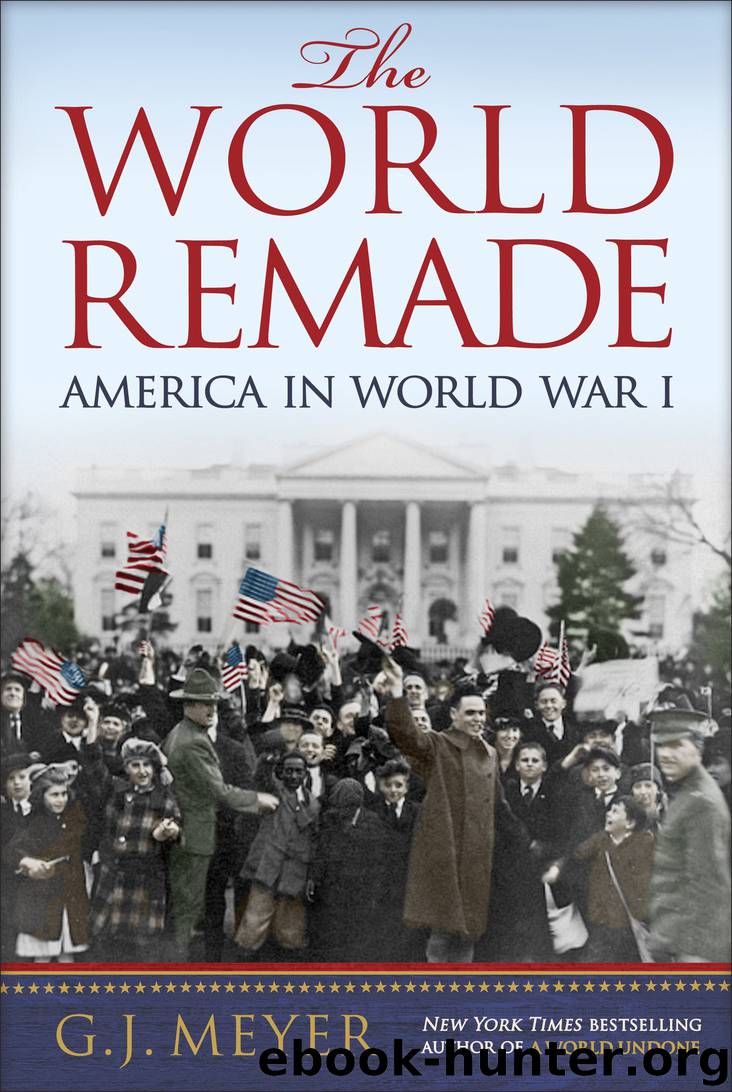
The World Remade by G.J. Meyer
Author:G.J. Meyer
Language: eng
Format: epub
Publisher: Random House Publishing Group
Published: 2017-03-06T16:00:00+00:00
Sir Douglas Haig, commander of the British Expeditionary Force
He approved of Pershing’s “quiet gentlemanly bearing—so unusual for an American.”
That same July Pershing, accompanied by his aide, Lieutenant George S. Patton, interrupted his work in Paris to accept an invitation to visit Douglas Haig at the headquarters of the BEF. He concealed behind his unflappable soldierly demeanor the shock of learning that the British had lost 125,000 men—killed, wounded, and missing—in their recent Arras offensive. This was triple the number of American troops then in France, more than Pershing expected to have under his command at the end of the year. It had not, however, stopped Haig from preparing still another of the ever-bigger, never-successful offensives that were making his name synonymous with the brainless use of brute force. (He called the machine gun a fad and clung until the end of the war to his conviction that mounted cavalry would ultimately sweep the Germans from the field.)
This new attack, to be launched at the end of July and known as the Third Battle of Ypres, was to be bigger than Nivelle’s. It was to be bigger even than Haig’s own 1916 Battle of the Somme, which had cost the Entente sixty thousand casualties, including almost twenty thousand dead, on its first day. Third Ypres was preceded by an artillery barrage that poured four million rounds, a hundred thousand of them poison gas, down on the German defenses. But when the whistles finally blew and the infantry climbed out of its trenches and advanced, Third Ypres turned into another protracted, heartbreaking failure. It would go on for more than three months, moving the Allied line two miles forward at a cost of three hundred thousand casualties. It would culminate in November in the agony of mud and blood to be remembered forever as Passchendaele.
There were some 65,000 American troops in France by the time of Third Ypres, but not one of them had seen any action. Pershing was sticking firmly to the War Department’s plan, to the teeth-grinding exasperation of the British and French. The troops of the AEF, for some obscure reason now called “doughboys” by the war correspondents and headline writers (Pershing had rejected the suggestion that they be called “sammies”), were not to be sent into combat until the two original conditions had been met. They had to be brought up to what Pershing regarded as a professional level of readiness, and there had to be enough of them to take up a position on the front comparable to those of the British and the French. Before the end of September, a report prepared by Pershing’s staff informed a surprised Washington that this was not going to be possible until the spring of 1919. New troops were arriving too slowly, and were in need of too much training, for anything better to be possible.
The lead elements of the AEF’s First Division, upon arriving in France in late June, had been received with wild enthusiasm everywhere they went. When
Download
This site does not store any files on its server. We only index and link to content provided by other sites. Please contact the content providers to delete copyright contents if any and email us, we'll remove relevant links or contents immediately.
Fanny Burney by Claire Harman(26574)
Empire of the Sikhs by Patwant Singh(23046)
Out of India by Michael Foss(16825)
Leonardo da Vinci by Walter Isaacson(13260)
Small Great Things by Jodi Picoult(7091)
The Six Wives Of Henry VIII (WOMEN IN HISTORY) by Fraser Antonia(5470)
The Wind in My Hair by Masih Alinejad(5063)
A Higher Loyalty: Truth, Lies, and Leadership by James Comey(4926)
The Lonely City by Olivia Laing(4777)
The Crown by Robert Lacey(4776)
Millionaire: The Philanderer, Gambler, and Duelist Who Invented Modern Finance by Janet Gleeson(4433)
The Iron Duke by The Iron Duke(4331)
Papillon (English) by Henri Charrière(4232)
Sticky Fingers by Joe Hagan(4156)
Joan of Arc by Mary Gordon(4069)
Alive: The Story of the Andes Survivors by Piers Paul Read(4003)
Stalin by Stephen Kotkin(3927)
Aleister Crowley: The Biography by Tobias Churton(3612)
Ants Among Elephants by Sujatha Gidla(3446)
